The opposite of a good idea
Winkletter • 3 Aug 2026 •
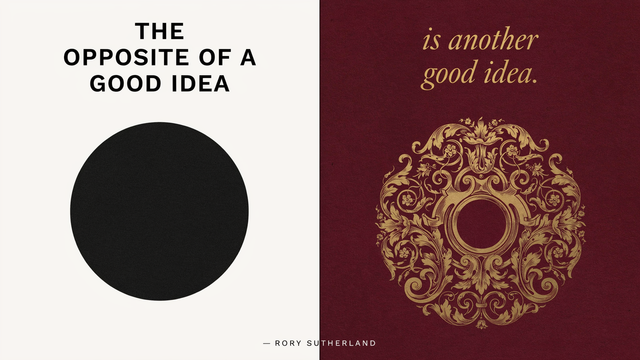
Adman Rory Sutherland often says, “The opposite of a good idea is another good idea.” When you start to factor in human psychology, things get a little weird. Bold and minimal is one good idea. Subtle and ornate is its opposite. People optimize for different things. And even the same person over time loses interest in their preferred choice and craves its opposite.
We’re always presented with trade-offs. This is why I often say that every rule implies its opposite. This is what philosopher Paul Grice called conversational implicature. The advice itself implies there’s a tempting other choice and a context within which it makes sense. “Show don’t tell,” implies that “Tell don’t show,” also applies in specific situations.
Innovation often centers around these trade-offs, according to Genrich Altshuller. With “Show don’t tell” we have a contradiction: the speaker wants to present convincing evidence and also form a compelling conclusion. Telling the conclusion is never as impactful as letting the audience form their own conclusions. But, this opens the possibility that evidence will be misinterpreted. Knowing this contradiction exists can help resolve the contradiction, usually through some form of separation.
- Separation in time: Use scene and summary structure. Show the scene. Tell through summary.
- Separation in space or structure: The narrator tells as a framing device while the narration shows in detail.
- Separation by scale: A detail is shown in isolation, but at the same time works to tell the conclusion. “If someone tries to tamper with the evidence, then we’ll know they are the killer.”
If you spot a good idea in the wild, don’t copy it. Look for its opposite. Look for a contradiction. Look for an innovation that resolves that contradiction. That’s how to turn one good idea into many more.