What's in a line?

Winkletter • 2 Oct 2025 •
What can a single line do? As a unit of discourse, we don’t think often about the shape of a single sentence. A writer’s natural process looks a bit like an inexperienced artist, drawing an eye, then another eye, before they start placing the mouth and face on the page.
But a single sentence can have one of a hundred shapes. I’m thinking of writing a daily line as a minimum daily post to get me using social media again. As I was putting together ideas about what form those lines could take, I realized I really do need this practice to improve my repertoire.
Here are 16 one-line templates I plan to use. I’ll probably add to these later, but I was surprised at how interesting these forms turned out to be.
- A question. A provocation in the form of a question. It can spark curiosity, self-reflection, or challenge assumptions.
What did the house remember that its owners had forgotten?
- First line/final line. A line that suggests beginnings or endings. It may open a story, essay, argument, or reflection—or leave behind an echo that lingers.
This was not the first time history had been rewritten by accident, and if history’s any guide, it won’t be the last.
- Wordplay. A line that hinges on wit, pun, or unexpected linguistic twist. It works equally well in light prose, headlines, or verse.
The knight’s greatest armor was his irony.
- Definition. Recasting the meaning of a word, or inventing one, to reveal a new way of seeing.
Brand: the story people tell about you when you’re not in the room.
- Truth bomb. A compressed observation or statement that resonates with weight, often more suggestive than specific.
Most disasters begin with calendars filling up.
- The pitch. A one-sentence idea framed as a hook, slogan, or concept. Can sell a story, product, or worldview.
Sit in silence, together, at the world’s largest conference for introverts.
- Aesthetic text. A line shaped by form—through rhythm, symmetry, repetition, or rhetorical flourish—so that how it sounds is as striking as what it means.
Fewer clicks, faster fixes, better business.
- Imperative Instruction. A directive or command that provokes action, whether literal, ironic, or metaphorical.
Write the apology before you need to give it.
- A rule. A maxim, principle, or aphorism framed as a guideline. Useful across disciplines: business, art, life.
If your customer has to ask, you’ve already failed.
- A story in a line. A compressed narrative that contains suggestion of a character, conflict, and resolution within one sentence.
She mailed the letter, then changed her name before it arrived.
- Creative constraint. A line generated under a deliberate restriction—syllable count, word length, grammar, or pattern. The constraint creates interest.
(Monosyllables only): This is how small truths grow tall and then fall down.
- Defamiliarization. A reframing of the everyday so it feels strange, often by describing it as if new or alien.
Meetings at our office are scheduled social events that convince tired employees they’d rather be working.
- Overextension. Taking a well-known phrase or cliché and carrying it past its expected boundary.
Time is money, but money can’t buy back your time.
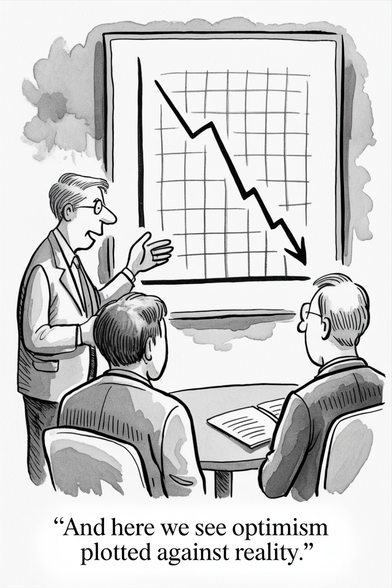
- The punchline. A line that completes, contrasts, or undercuts another piece of content (like an image, chart, or story fragment).
Quarterly report, caption: “And here we see optimism plotted against reality.”
- Pure nonsense. A line that delights through sound, rhythm, or absurdity, unconcerned with making sense.
Our rivals promise synergy; we promise flibberdy-flop.
- Fill-in-the-blank. A sentence with blanks or omissions that invites the audience to co-create by filling in the gaps.
I am the ___, and you are the ___, together we ___.